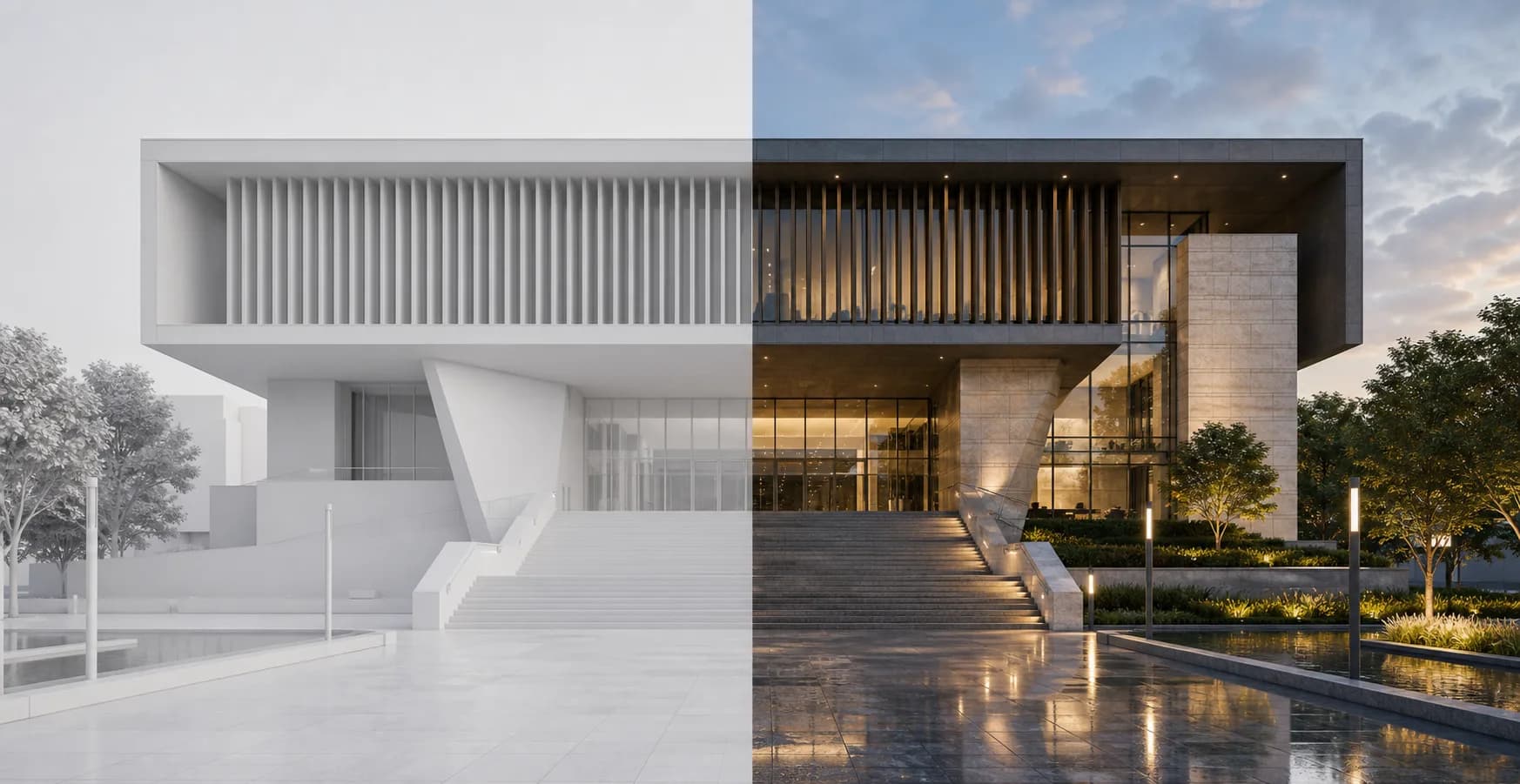
Quick comparison
Rendervi vs Veras: what changes in daily work
| Decision point | Rendervi | Veras |
|---|---|---|
| Main fit | Architecture-first render studio for project images, modes, edits, history, and presets. | Plugin-based ideation from model views, geometry control, selected-area rerenders, and same-seed variations. |
| Architecture control | Built to preserve source composition, design intent, and real project context. | High fit. Its main advantage is the authoring-tool connection; browser-first post-production and project organization are less central. |
| Consistency | Saved presets can carry materials, atmosphere, site cues, and visual direction across views. | Medium fit for repeatable same-project output. |
| Edits and polish | Render, Preset, Environment, Photo-Realism, Edit, and Upscale workflows are built into the product. | High fit for controlled architecture revisions. |
| Starting price | 10 free renders; $12.99/month for 50-150 renders. | $34 / seat / month |
Where Veras really wins
Plugin-based ideation from model views, geometry control, selected-area rerenders, and same-seed variations.
- Your team works directly inside supported BIM and CAD tools all day.
- You want AI ideation to stay closely connected to the live model substrate.
- You value geometry-aware controls during early exploration.
Where Rendervi is the better fit
Rendervi is built for architects who already have a model view, plan, draft render, or approved image and need to move toward a cleaner presentation visual without losing control of the design.
- You want a cleaner render studio beyond the modeling plugin context.
- You need stronger before-and-after style workflows for review and presentation.
- You care about fast movement from preview to persuasive image.
Features for architects
Architecture feature checklist
| Feature | Rendervi | Veras |
|---|---|---|
| Material change | Yes | PartialVia model controls |
| Saved visual presets | Yes | No |
| Inpainting / local edits | Yes | PartialPlugin workflow |
| Project history | Yes | No |
| Architecture render modes | Yes | YesPlugin-based |
| Environment controls | Yes | Partial |
| Photo-realism workflow | Yes | Partial |
| Video generation | YesImage-to-video | YesVeras Video |
| Upscale | Yes2K / 4K | No |
| Team workspaces | Yes | PartialSeat-based plans |
| Starting price | 10 free renders; $12.99/month for 50-150 renders | $34 / seat / month |
| Free trial | Yes10 free renders | Trial availability varies |
FAQ
Questions before you choose a tool
Practical answers for architecture teams deciding between a broad image tool and a render workflow built around production.
Is Veras better if my team lives in Revit or SketchUp?
It can be, especially during early ideation. Veras is strongest when staying close to the live model is the main priority.
When does Rendervi become the better fit than Veras?
Rendervi becomes stronger when the main job is producing precise architectural visuals quickly from existing previews, plans, or approved renders.
What makes Rendervi different from a generic AI image generator?
Rendervi is organized around architecture projects, not one-off prompts. It keeps image history, supports local edits, offers render modes, and lets teams save visual presets so materials, atmosphere, and project identity can carry across future views.
Can Rendervi keep multiple views of the same project consistent?
Yes. Rendervi presets are built for consistency across camera angles. A saved preset stores material direction, lighting, weather, vegetation, people strategy, and recurring visual cues so another project view can reuse the same direction without starting from scratch.
Does Rendervi support controlled edits after the first render?
Yes. Rendervi supports local area editing for changes such as facade materials, small composition fixes, object removal, or adding a detail while keeping the rest of the image stable.
Which Rendervi modes matter most when comparing tools?
The core modes are Render for polishing a model view, Preset for matching an approved visual direction, Environment for site context, Photo-Realism for final polish, Edit for targeted changes, Image-to-Video for motion output, and Upscale for higher-resolution presentation output.
Best fit summary
If your team mainly wants precise architectural renders, cleaner consistency, and a faster route from approved inputs to usable output, Rendervi is usually the better product choice. If you care more about plugin-based ideation from model views, geometry control, selected-area rerenders, and same-seed variations. Veras may be the stronger option for that specific job.