Advice to Improve Your Architecture Portfolio
June 30, 2026
A strong architecture portfolio is not just a collection of good images. It is a short, clear argument that you can think, draw, model, communicate, and contribute to a real studio.
Short answer
To improve an architecture portfolio, make it easy to read quickly. Show your best work first, explain your role, include process, keep the layout calm, and make every image strong enough to support the project. The goal is not to show everything you have made. The goal is to help a hiring manager understand why you are worth interviewing.
What your portfolio needs to prove
Architecture firms usually scan portfolios fast. They are looking for design judgment, technical ability, communication skill, and evidence that you can contribute to the type of work they do. For students, that means showing potential and clear thinking. For architects, it means showing project experience, responsibility, and taste.
A good portfolio answers five simple questions: what did you design, why does it matter, how did the idea develop, what exactly did you do, and how well can you present the final result?
1. Lead with the work you want to be hired for
Put your strongest and most relevant project first. If you want a residential role, lead with residential work or a project that proves similar skills: plans, sections, facade development, material control, and atmospheric images. If you want an urban design role, lead with site strategy, diagrams, public realm thinking, and large-scale drawings.
Do not open with a weak project just because it is recent. The first project sets the standard for the whole portfolio.
2. Make the first scan effortless
Assume the first review is quick. Use clear project titles, short descriptions, readable captions, and a consistent layout. A hiring manager should understand the project type, location or brief, year, tools, and your role without hunting for the information.
Keep the application version focused. A short PDF with your best projects is usually more useful than a long archive. You can keep a longer version ready for interviews.
3. Show process, not only final images
Final renders are important, but they do not prove how you think. Include the drawings and studies that explain the project: concept diagrams, site analysis, massing options, plan development, section studies, material tests, and one or two key details.
For students, process is often the strongest proof of potential. For working architects, it shows judgment: how you move from a messy brief to a controlled architectural proposal.
4. Be honest about your role
If a project was team-based, say what you were responsible for. Did you model the facade, draw the plans, build the diagrams, create the renders, coordinate the documentation, or help with client presentations? Clear role labels make you look professional.
Do the same for tools. Mention Revit, Rhino, SketchUp, Archicad, Grasshopper, Enscape, V-Ray, Adobe tools, or AI workflows where relevant. Keep it factual. The work should still be the main story.
5. Improve your renders with Rendervi
Your renders do not need to be the only thing in the portfolio, but they matter. A strong render helps a reviewer understand atmosphere, material quality, scale, and the promise of the design. A weak render can make a good project feel unfinished.
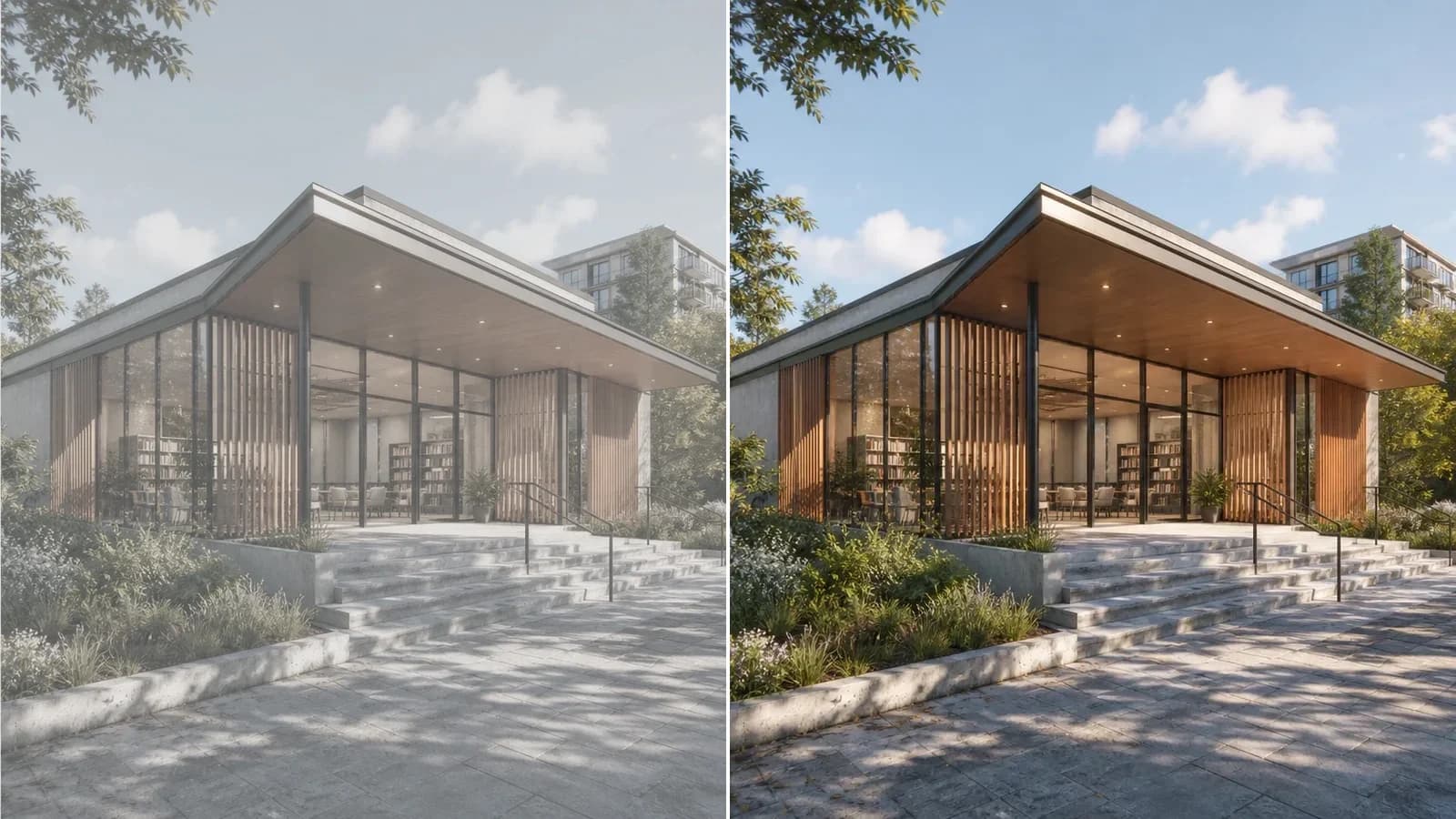
Rendervi is useful when you already have a view but the image is not strong enough for a job application. You do not need to rebuild the scene or re-render in your 3D software. Upload your existing render, SketchUp view, Revit export, Rhino screenshot, or clay image to the app, then use Rendervi to improve realism, materials, light, context, and resolution.
This is especially helpful for students and early-career architects. You can improve the visual quality of older work without spending days rebuilding files. The important rule is simple: improve the image, but keep the design honest. Do not let a better render change the architecture you are presenting.
6. Keep the layout quiet
Let the work breathe. Use a simple grid, consistent margins, and one or two type sizes. Avoid decorative graphics, busy backgrounds, tiny text, and too many images on one page. If the layout is fighting the project, simplify it.
Every spread should have a job. One spread might explain the concept. Another might show plans and sections. Another might focus on the key render and material idea. Do not make every page do everything.
7. Edit hard
Most portfolios improve when you remove work. Cut weak projects, repeated images, unclear drawings, and pages that do not add new information. If two pages say the same thing, keep the stronger one.
A smaller portfolio with clear project stories feels more confident than a large portfolio that asks the reviewer to find the good parts.
8. Build two versions
Make one short application portfolio and one longer interview portfolio. The application version should be easy to send, quick to scan, and focused on getting the interview. The interview version can include more process, technical drawings, and discussion material.
Also keep a small web version or PDF link ready. Some firms prefer uploads, some prefer email attachments, and some review links. Make it easy for them.
Final checklist before you send
- The strongest relevant project appears first.
- Every project has a short brief, year, tools, and your role.
- The portfolio includes process drawings, not only finished renders.
- Plans, sections, diagrams, and renders are readable at PDF size.
- Renders look polished, but the architecture is still accurate.
- The file name includes your name and the role or year.
- There are no broken links, missing fonts, typos, or huge file-size problems.
Make old project images portfolio-ready
Upload an existing architecture image to Rendervi and improve the render quality without rebuilding the model, setting up lights, or starting a full visualization workflow again.
Improve a renderSources
- AIA: Looking for a job in architecture? Here are tips from hiring managers
- NCARB: How to create the perfect architecture portfolio
- ArchDaily: 12 tips on making an architecture portfolio
- ArchDaily: 6 tips on creating a two-page portfolio to win a job interview
- Bespoke Careers: Employers share architecture portfolio tips
- Bespoke Careers: Guide for creating an outstanding architecture portfolio